Gulmohar, Maharashtra Nature Park, Mahim
“Wonder is the foundation of all philosophy, inquiry the progress, ignorance the end”
~ Michel de Montaigne


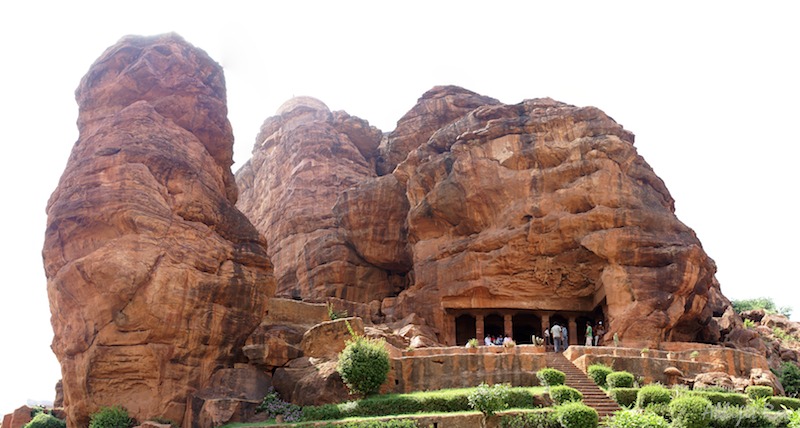
Badami (Kannada: ಬದಾಮಿ), formerly known as Vatapi, is a taluk in the Bagalkot district of Karnataka, India. It was the regal capital of the Badami Chalukyas from 540 to 757 AD. It is famous for rock cut and other structural temples. It is located in a ravine at the foot of a rugged, red sandstone outcrop that surrounds Agastya lake.
The rock-cut Badami Cave Temples were sculpted mostly between the 6th and 8th centuries. The four cave temples represent the secular nature of the rulers then, with tolerance and a religious following that inclines towards Hinduism, Buddhism and Jainism. cave 1 is devoted to Shiva, and Caves 2 and 3 are dedicated to Vishnu, whereas cave 4 displays reliefs of Jain Tirthankaras. Deep caverns with carved images of the various incarnations of Hindu gods are strewn across the area, under boulders and in the red sandstone. From an architectural and archaeological perspective, they provide critical evidence of the early styles and stages of the southern Indian architecture.
~Wikipedia


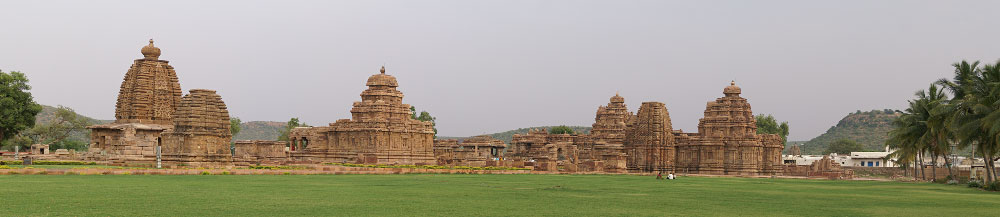
Pattadakal (Kannada - ಪಟ್ಟದ್ಕಲ್ಲು) is a town in the Indian state of Karnataka The town lies on the banks of the Malaprabha River in Bagalkot district of North Karnataka region. It is 22 km from Badami and about 10 km from Aihole. The group of 8th century CE monuments in Pattadakal are the culmination of the earliest experiments in the vesara style of Hindu temple architecture. They were designated a World Heritage Site in 1987. The town displays both Dravidian (Southern) and the Nagara (Northern, Indo-Aryan) styles of temple architecture and this temple is the finest testimony for Vishwakarma Brahmin Stapathis in planning and sculpting this architectural wonder~ Wikipedia


Early inscriptions call this town Ayyavole and Aryapura. Aihole has its own historical significance and is called as cradle of Hindu rock architecture. Many temples and caves of historical importance can be found at Aihole.~ Wikipedia
Aihole was the first capital of the early Chalukyas. Here they built over 125 temples in various styles and is said to be a laboratory of experiments in rock cut architecture. Pulakesi I, one of the greatest rulers of this dynasty, moved the capital to Badami nearby. Badami was then known as Vatapi. It is from these temples that the Chalukyas gained their experience and went on to build the great temples of Pattadakal. The first phase of temple building in Aihole dates back to the 6th century CE, the second phase up to the 12th century CE. Some temples were even built as early as the 5th century CE.


;;; Hash Function by Dan Bernstein
(defun hash-DJB (str)
  (declare (type simple-string str)
    (type (unsigned-byte 32) hash)
    (optimize speed (debug 0)))
  (let ((hash 5381))
    (loop for x across str
     do (setf hash (ldb (byte 32 0) (+ (ldb (byte 32 0) (+ (ldb (byte 32 0) (ash hash 5)) hash)) (char-int x))))
     finally (return hash))))

;;; Hash Function by Dan Bernstein (newer)
(defun hash-DJB2 (str)
  (declare (type simple-string str)
    (type (unsigned-byte 32) hash)
    (optimize speed (debug 0)))
  (let ((hash 5381))
    (loop for x across str
       do (setf hash (ldb (byte 32 0) (logxor (char-int x) (* hash 33))))
       finally (return hash))))

;;; Hash Function from GAWK, a variation from the verwion from SDBM
(defun hash-SDBM (str)
  (declare (type simple-string str)
    (type (unsigned-byte 32) hash)
    (optimize speed (debug 0)))
  (let ((hash 0))
    (loop for x across str
       do (setf hash (ldb (byte 32 0) (+ (char-int x) (ldb (byte 32 0) (ash hash 6)) (ldb (byte 32 0) (ash hash 16)) (- hash))))
       finally (return hash))))

;;; An algorithm proposed by Donald E. Knuth in The Art Of Computer Programming Volume 3
(defun hash-DEK (str)
  (declare (type simple-string str)
    (type (unsigned-byte 32) hash)
    (optimize speed (debug 0)))
    (let ((hash (length str)))
      (loop for x across str
  do (setf hash (ldb (byte 32 0) (logxor (char-int x) (logxor (ldb (byte 32 0) (ash hash 5)) (ash hash -27)))))
  finally (return hash))))